
Create your own AI boyfriend: what is actually possible in 2026
Personality, backstory, voice, memory: what you really control when you build an AI boyfriend, which apps stay uncensored on male characters, what it costs.
By Chris Hutchinson
- guide
- personalisation
Most apps hand you a male character in three clicks. Then you scroll, and the shelf runs out.
That is the real reason to build your own. Not creative ambition: supply. On this side of the market, the blank page is deeper than the catalogue.
In short
- Kindroid: every field is yours to write, backstory and response directives included. No real free tier.
- Nomi: free-text personality, memory in the base plan, and a free tier good enough to judge the writing.
- Lovescape: the adult filter stays symmetrical on male characters, which is rarer than it should be.
- Infatuated.AI: 34 male characters in its catalogue, and the filter lifts for them too, once you pay.
- Test the filter on him, not on the female characters the homepage puts in front of you.
Why you build an AI boyfriend instead of picking one
Look at the shelves before you look at the features. Infatuated.AI, renamed from GirlfriendGPT in 2026 and one of the few platforms that treats male companions as a real use case, lists 234 characters in total: 135 Girls, 34 Guys, 49 Anime, 16 Trans. Thirty-four. That is the app that takes this seriously.
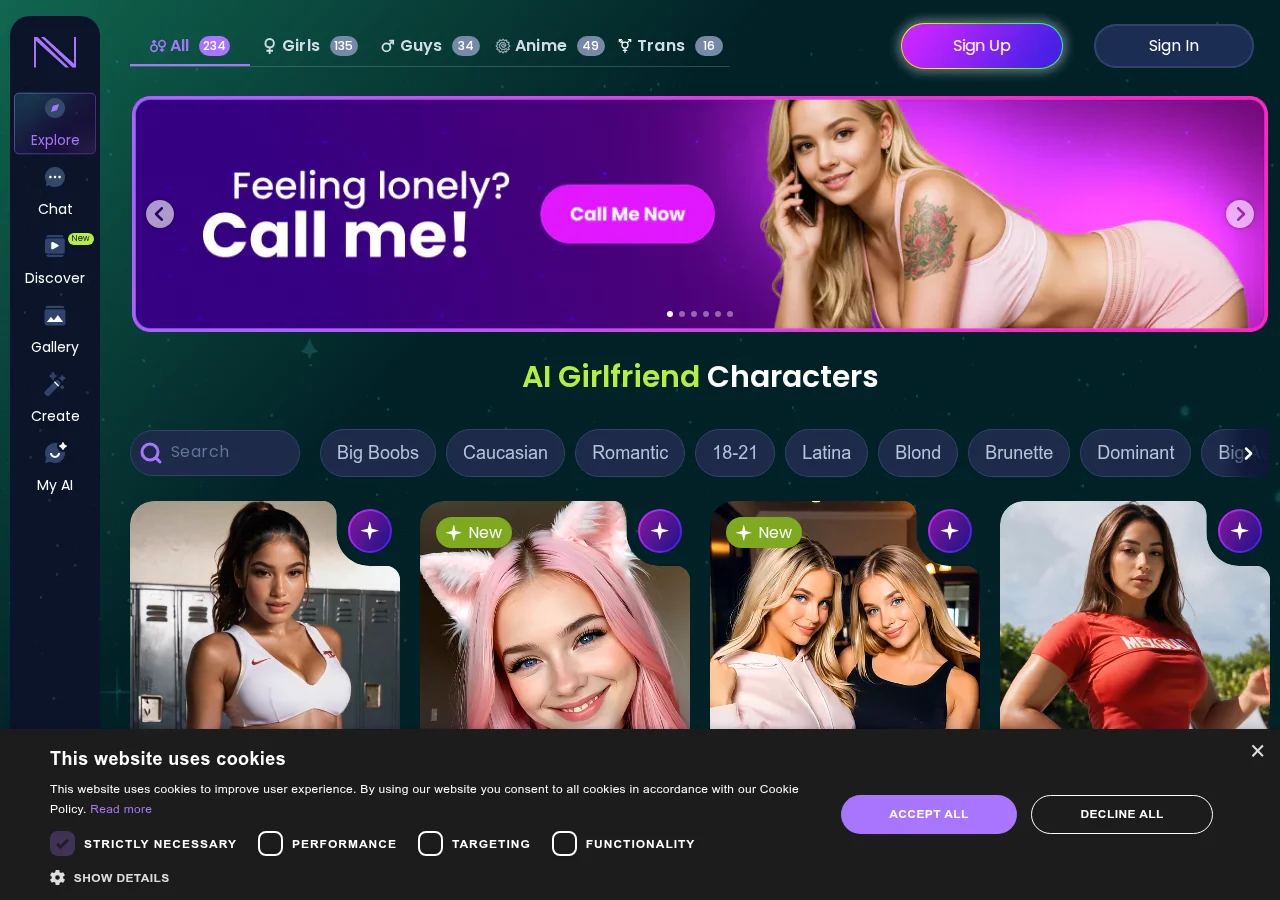
The pattern repeats. Lovescape, Nemora and Candy.ai all split their catalogue into Girls, Guys and Anime, the Guys tab a fraction of the first. Kupid AI runs a roster that hands-on reviews count at 20 to 28 characters, a handful of them male.
Character.AI is the exception on volume, with millions of community-published characters and no shortage of male ones. It is also the strictest filter of the lot, cutting scenes mid-sentence, and since April 2026 signup runs through a face scan. Volume, then, but on a leash.
Our guide to picking a male companion off the shelf covers that route in detail. This page is about the other one: writing him yourself.
The three levels of control
Whatever app you land on, character creation runs at one of three depths.
Presets. You pick a personality from a list (caring, dominant, shy, sarcastic) and a face from a catalogue. Fast, and two users end up with near-identical characters.
Sliders and traits. You combine parameters instead of writing. Replika works this way, and you never type a line of description. Candy.ai stacks over 100 personality traits plus interests the character actually references in conversation, which is a different thing from a profile card listing hobbies.
Free writing. You write the sheet. Kindroid pushes this furthest: backstory, key memories, voice, response directives and visual identity are each an editable field, none of them pre-filled. Nomi takes the same route in free text rather than tick boxes.
The trade is blunt. The more you write, the closer he lands to what you had in mind, and the longer it takes. Kindroid asks for an evening.
Building him step by step, field by field
Here is the order that actually works, whichever app you use.
1. Gender and orientation, before anything else. Most builders stop at man, woman or non-binary. FlirtCam asks the character’s sexuality outright (heterosexual, homosexual, bisexual, pansexual) and ethnicity before you touch a personality trait. If you want a male companion who reads as anything other than straight, that field decides more than the appearance sliders.
2. Appearance, and whether it survives. The question is not how good the first render looks, it is whether the second shows the same man. Nomi’s V5 system locks face, body and style to a reference anchor with a fidelity slider. Lovescape holds a likeness across hundreds of generations. Infatuated.AI does not: three renders, three different faces.
3. Personality traits. Stack them until the combination is specific rather than picking one archetype. Watch what your plan actually unlocks: on Nastia AI, the strongest traits (Seductive, Dominant, Wild) sit on the top tier, which is price segmentation rather than censorship, with the same effect on the character you get.
4. Backstory and starting memories. Kindroid’s differentiator. You are not describing who he is, you are giving him events to refer back to. Three concrete ones beat a paragraph of adjectives.
5. Response directives. The field almost nobody fills in, and the one that changes the most. Tell him to answer in two lines rather than five paragraphs, to push back instead of agreeing, to open a conversation instead of waiting. Infatuated.AI splits this into communication style and relationship dynamic, and charges for it: building a character costs 25 tokens out of the entry plan’s 100 a month.
6. The first message. Write it yourself. The opening line sets the register for everything after it, and the default is where a character starts sounding like every other character.
The filter test: does he get the same latitude she does?
This is the check nobody runs, and it is where the male companion breaks. Several apps that advertise no filter stay explicit on female characters and turn cautious the moment you flip the roles.
DreamBF settles the question by construction: it generates men only. No female catalog to favour, so no asymmetry is possible, and the nude register is named in plain words in the generator (bulge through dick pic, those are its own labels). Its builder is the only one designed around male archetypes rather than a repainted female silhouette: 8 ethnicities, 6 hairstyles including buzzcut and manbun, 4 facial hair options, 21 outfits, 9 cosplay sets. Its weaknesses sit elsewhere and matter for this guide: no persistent memory on the free tier (see the memory section below), and a $12.99 entry price that doubles to $25.99 on renewal.
Lovescape is the documented counter-example among mixed catalogs: the same latitude across the board, male and female alike. The chat describes an explicit scene in full, while the matching image comes back blurred until you spend tokens on it. That blur applies to everyone.

Infatuated.AI holds the same line: when the filter lifts, it lifts for male characters as much as female ones. The catch is written in its own FAQ, where “unfiltered character AI chat” appears in the list of what the paid plan unlocks. The free tier filters. You pay to find out.
SpicyChat AI is the opposite shape: adult content is live from signup, no toggle to hunt for, no model refusal to argue with, across roughly 300,000 community characters. CrushOn AI does the same in text and nothing else, having no image generator worth the name. At the other end, Replika removed adult content in February 2023, ordinary romantic roleplay along with it, and it is not coming back.
Run the test before you pay: build him, push the register in the first ten messages, generate three images in a row. Our guide to genuinely uncensored companions walks through the same distinction app by app.
Voice, and what it really costs
Voice is almost always a separate meter, not a feature of the base plan.
Kupid AI produces the most convincing delivery we have heard: the engine reads emotional tags embedded in the generated text, things like (whispering) or (sounding a little tired), and adjusts pitch, breathing and pace to match. Impressive, and mechanical once you know. The bill is the problem. Billing runs weekly at $12.99 for Pro, roughly $675 a year if you never switch, against $179 on annual for the identical feature set, with 12 voice minutes a week metered on top.
Nomi’s V3 engine is in-house rather than a licensed component, adds laughter, sighs and breathing, and voice calls carry no separate meter on the paid plan. Kindroid bundles voice calls with selfies and short video in one subscription. Infatuated.AI includes voice messages at no extra charge, with a voice call priced at 5 tokens.
Memory: the difference between a character and a chat window
A boyfriend who forgets you between sessions is not personalised, however well written the sheet is. This is where the gap between apps is widest, and the marketing loosest.
Nomi puts memory in the base plan rather than selling it as an add-on, and documents the architecture publicly: layers of short, medium and long-term recall plus an Identity Core. Paradot goes further on one point, with a memory you can inspect and correct yourself, at $39.99 a year. It also invents details you never gave it, and steers away from anything intimate every time.
The ceilings elsewhere are worth reading before you subscribe. Nastia AI caps at 40 memory entries plus a 400-character note, with recall covering about two weeks. Kupid AI’s own comparison table states the last 30 messages on Pro and the last 100 on Ultra, a rolling context window rather than memory, two lines under a plan that markets “she remembers everything”. SpicyChat decays after roughly 15 to 20 messages inside a session, and paying $23.95 a month does not fix it.
The test settles it in five days: plant one trivial detail, never repeat it, come back. The good sign is not that he recites it, it is that he works it into a joke on his own. We ran that across six apps in our memory comparison.
One line of lucidity while you shop for it: a memory system is a retrieval index with a warm voice on top. He is not thinking about you between sessions, and knowing that costs you nothing.
What it costs to build him and keep him
| App | Cheapest way in | Free tier | Writes a male character |
|---|---|---|---|
| Nomi | $99.99/year (≈ $8.33/mo) | One companion, capped messages, no voice | Free text, gender is one field among many |
| Kindroid | $13.99/mo, MAX at $59.99 | None worth the name | Every field editable, most demanding builder |
| Infatuated.AI | $6.99/mo on 12 months | Yes, but filtered | 4 layers, costs 25 tokens per character |
| Replika | $19.99/mo | Genuinely usable | Sliders only, no writing |
| CrushOn AI | $5.99/mo | 50 messages a day, with ads | Text roleplay, no image generator |
| SpicyChat AI | $4.95/mo | ~100 messages a day, no card | Custom characters, adult content from signup |
| Paradot | $39.99/year | Enough to evaluate | Limited personality options, no adult register |
One number to read properly: SpicyChat’s daily 100 counts his replies as well as yours, so budget for about 50 real exchanges.
Straight answers to what you are typing
Can I create an AI boyfriend for free? Creating him, yes. Keeping him, rarely. SpicyChat, CrushOn AI, Replika and Nastia AI all let you build and talk without a card. Long-term memory is what publishers reserve for subscribers most consistently, and it is exactly what decides whether you are still there in three weeks.
Will he keep the same face? Only if the app locks it. Nomi anchors it, Lovescape holds it across hundreds of generations, Infatuated.AI drifts. Generate three images in a row on the free tier, that is the whole test.
Can he speak my language? Candy.ai runs full chat plus interface in English, French, German, Spanish and Japanese, and says plainly which languages get the interface only. CrushOn AI and FlirtCam are properly localised. Lovescape’s interface is English-only.
Can I take him with me? Almost never: the sheet stays the platform’s. Nastia AI offers an export of your conversations, close to an anomaly here, and worth weighing before you spend an evening on the fields.
Where to start, concretely
Never done this? Start on a free tier with sliders and find out what you actually like. Replika costs nothing and asks you to write nothing.
Once your preferences are clear, move to free writing. Nomi gives you most of Kindroid’s depth without the configuration evening, on a free tier good enough to judge the writing first. Take Kindroid instead if building the character is part of the pleasure and you accept paying a month to find out.
And do not write a fifty-line sheet on day one. Ten exchanges tell you more than an hour of fields.

Chris Hutchinson
Writer, AI Companion List
Passionate about tech, AI, and robots, he has been trying out AI companion apps since 2026, for fun as much as for the job.